


By Brian Baglow
Global tech conferences love to chase the next big wave. Walking the show floors at this year’s Web Summit in Lisbon, the energy was incredible. Across five packed pavilions, hundreds of companies, startups, and national delegations, from Tokyo to Georgia, Rio to Palestine, showcased their wares with single-minded energy.
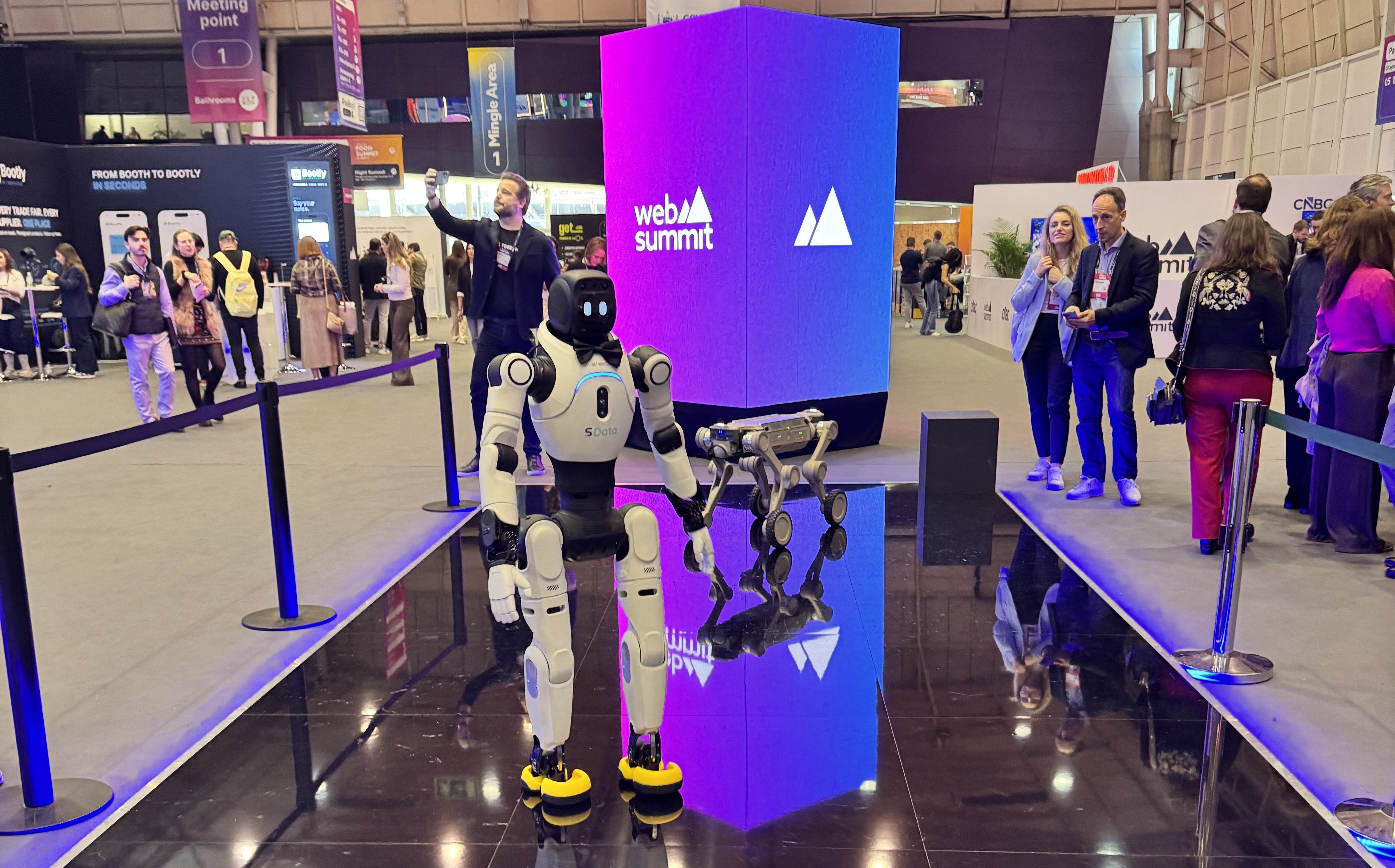
If you map the floor plan by volume, the landscape was crystal clear: Fintech, B2B SaaS, PropTech, Compliance, Cyber, and, of course, a staggering wave of AI applications and robots (robots everywhere!) It was a masterclass in hyper-specialisation, where every company appeared laser-focused on a single, discrete problem.
Getting to them, however, was an endurance test. Arriving at the venue drenched to the skin by torrential rain and having to slog along the wide-open promenade in front of the MEO Arena – which seemed like a kilometre of exposed outdoor trek in nothing more than my signature tweed jacket and waistcoat – I was a soaking mess.
Yet, step through the threshold into the speakers’ lounge, and you enter an entirely different dimension. It is a plush, cavernous wonderland featuring an inexhaustible, incredible buffet of fresh seafood, hot dishes, salads, and drinks on tap (including beer…) available all day. It’s a scale of hospitality and a level of logistical excellence I’ve never witnessed at a dedicated games event.
Yet, for an event of this monumental scale and luxury, walking the exhibition floors revealed a striking gap.
Where were the games? From two days of walking the show floor, I spotted maybe three games-related companies out of several hundred eager startups.
If you step onto the floor of Gamescom, GDC, or Develop, the visual assault is immediate: massive screens blasting cinematic trailers, towering banners, immersive art, and a sensory-rich celebration of worlds built from scratch. By contrast, Web Summit’s small startups were relegated to basic positions along endless rows of long chipboard benches stretching meters down each hall, identified only by modest name boards and category headers.
And then there was the merch – or rather, there wasn’t. At a standard tech or games expo, your (free branded) bag is usually groaning under the weight of knick-knacks – pens, notebooks, mugs, socks, and T-shirts. Here? Almost nothing.
Yet, step back and look at the people. The crowd wandering those halls – the developers, the entrepreneurs, the founders and funders – was identical to the demographic you would find at any major games conference. Drop them straight into GDC or Cologne, and they’d fit right in. Which makes the near-total institutional disconnect between tech and games all the more interesting.
From Lockdown to the Stage
That disconnect was thrown into sharp relief when Storm Charles brought Lisbon – and the Web Summit – to a grinding halt.
While the main halls emptied, the tech ecosystem adapted. Out of the chaos came the ‘Wind Summit’ – a delightfully unpolished, four-hour online scramble where self-selected founders took turns speed-pitching their products to an audience of stranded entrepreneurs from around the globe. It had heart, chaos, and a raw energy entirely missing from corporate keynotes. Dropping More Than Games into that room sparked a different kind of conversation: a reminder that onboarding, engagement, and retention aren’t solved by more dashboards, but by fundamental, playful design thinking.
And resilience pays off. Thanks to the tireless graft of the Web Summit team, the disruption became an opportunity. Alongside Claudio Pestano from Portugal’s eGames Lab (and we’re going to be talking FAR more about that in the near future…), we took to Stage four on Thursday afternoon to deliver our talk (Why game developers should be your next hire) before catching our flights home (unless you were flying to the US, in which case, bad luck…)
The Opportunity for Tech Founders
Rather than seeing the almost total absence of games as a failure, it should be viewed for what it truly is: a massive, untapped opportunity.
The message to the wider tech and investment community is simple. You can build all the AI models, data dashboards and SaaS pipelines you want, but if you don’t understand how people actually engage, stay, and interact, you risk losing them to a competitor, or using your product/service as little as possible.
It is time to bring our worlds together. The ‘interaction economy’ isn’t coming soon – it’s already here, and the tools, techniques, and talent born in games hold the answers traditional tech is searching for. We just need to open the door and invite them in.