


Responding to an advert for an artist, Scott Johnston joined DMA around 1990, while we were still in the first – the old old – office. The first I knew of his programming skills, however, was when he created the head of the eponymous Walker in the game of the same name. Rather than tediously drawing each frame of each rotation by hand in DPaint, he wrote an AmigaBASIC program to generate them automatically. As an encore, he taught himself the 68000 assembly language used by the Amiga and started to write 3DGame, inspired by the genre of game epitomised by the popular Dungeon Master.

While Scott coded 3DGame, I had moved on from converting Amiga Ballistix graphics to the Commodore 64, and was now doing the same for Shadow of the Beast. It was a game of such size that it could only be squeezed into a 5 ¼ inch floppy disk or a cartridge. In either case, only one level would fit in memory at a time. When each was loaded, only a blank screen appeared until it was ready. On one of my regular bike rides down to the large Victorian home of the programmer, with new new graphics on a cassette, the project had reached the point of playability. Now those blank moments between levels were glaring. I offered to write text to fill the gap. It was only a few lines per loading screen, but it seeded the idea that I could provide a narrative for a game.
Outside of work, I wrote in my spare time. In my dream life, I had a day job creating games, while writing novels in the evenings. Candles would be burnt well into the night, wearing down my quill in my cottage’s study, as I rendered philosophical imponderables in the medium of prose. Well the candle was a 40-watt lightbulb, the quill was a Rotring draughting pen and the cottage study was a cupboard in my bedsit. As a location, though, it was auspicious: the very site where in the early 1800s Mary Shelley wes reputed to have had the idea for Frankenstein. There was even a plaque to show it.

It was a small indication of the organic nature of development at DMA, especially in the early 90s. Dave Jones, when I told him was I was going to be doing, merely made a noise somewhere between a grunt and what might have been an “OK”. Endorsement enough! It also, as it turned out, spoiled me enormously with respect to the creative freedom I expected.

I started searching for inspiration, bringing my love of SF to bear.
Although I began to have a small role in the design of the game itself, with Scott designing most of it, writing very much did not drive game development. Limitations of memory, storage and processor power meant that almost all of the story and background was necessarily contained in the accompanying manual. The story had little impact on the design of the levels, other than names of places. So while I spend an age writing and refining the intro story, it served only as a half-story, deliberately unresolved, with the second half being the game itself. The story was a scene-setting device, with the player providing the ending.

Not that the story remained the same from the beginning to the end of the project. I was lucky enough that Scott had given me /carte blanch/ to create whatever I felt best. And my best work was done away from the office, at home in winter, in a darkness banished only by the glow of the screen.

It was a legacy from playing tabletop roleplaying games like Cyberpunk 2020, The Call of Cthulhu and especially Traveller. The richer the background, the more apt the story. And so I chose to make faster than light travel impossible in the HG universe, taking established tropes and inverting them. In Star Trek, getting from world to world is easy. Not so in Hired Guns. I wanted it to be difficult, extremely so. But it wasn’t arbitrary, it fed into the plot.
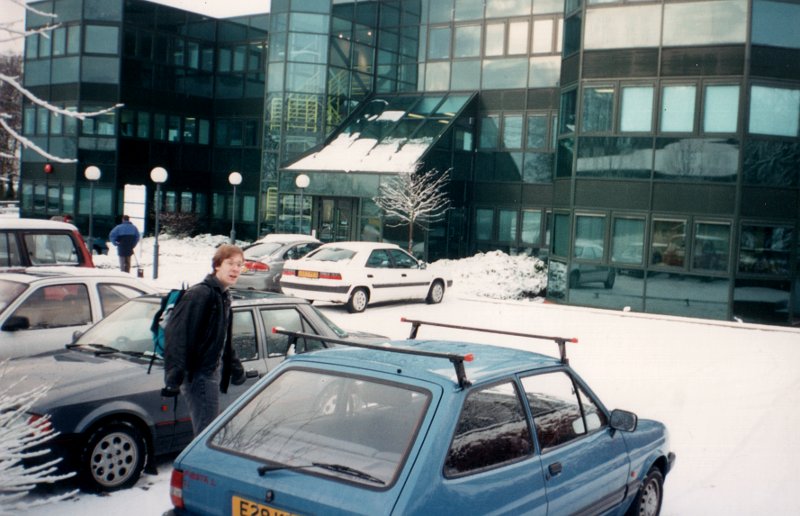
Some writers will also tell you that – just occasionally – it is no longer the case that they are creating a story, they are discovering it. This is part of the answer to the old question of where writers get their ideas. It is from everything you experience, everything you read and everything you feel. It’s also a feeling which can sneak up on you at two in the morning and sometimes it doesn’t go away. I began to feel that I was no longer writing the Hired Guns story, but discovering part of a larger truth.
And you thought writers just made stuff up?
But what pragmatism brings you, it can also take away. Writing for computer games in the 90s (aside from the obvious counterexample of text adventures) almost never drove game development: programmers did. Artists began to have a greater influence over the game’s direction towards the end of the decade, but for now the gameplay was entirely Scott’s doing. Any story was added as a kind of layer on top. I thought of the story more as a set of extras surrounding the game, and in the case of short level descriptions, as set dressing. Working around the existing game elements meant developing the story in, if not exactly isolation, then at a certain distance.

But I knew what the real story was, even if it led to some dark moments at unhealthy hours of the morning, and even if it was three sequels down the line. All communication had been lost with Earth in a /Boundary/ event, as the backdrop. Distant, mysterious and frightening. The team is sent on a mission to an unrelated world, a hostage rescue where the hostages don’t exist. It is in fact a weapons proving ground and they are live, expendable, test subjects. There was a connection to the story of Earth, but even in 1993 I wasn’t in a hurry to reveal it.
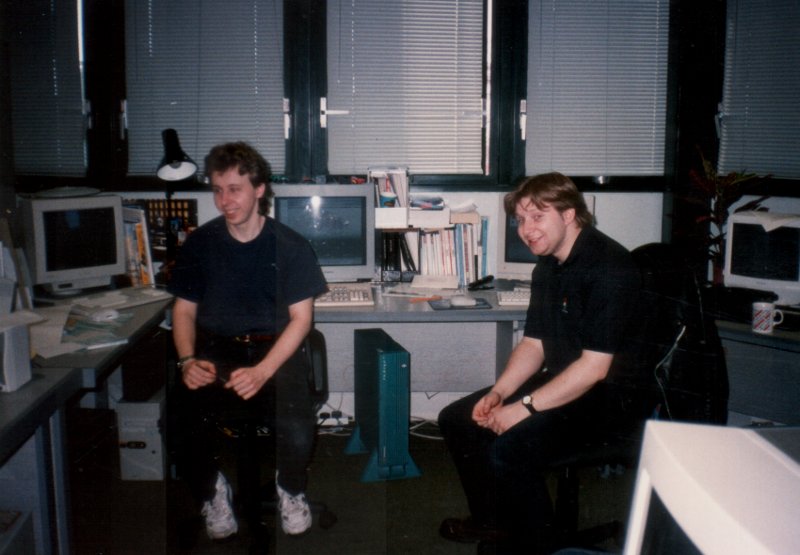
My first professional writing, and the darkness had somehow spilled into the waking world.
So what happened to Earth?
A spoiler, if you assume I will ever finish the story, and even then there’s a twist yet to be had, but of all the forces in the universe which could silence a world, the one which frightened me – and still does because they are non-fiction – is this one.
Category Seven: Dangerous Unnatural Forces.
[You can find Steve’s first Manual Override column here]